
Is it time for meniscal repair surgery?
When a torn meniscus starts stealing your sleep, your stability and your sport, meniscal repair surgery can give them back – and protect your knee’s long-term health in a way that simply removing the torn tissue cannot. Mr Ashwin Unnithan is a Consultant Orthopaedic Surgeon with a specific clinical interest in meniscal repair, and at consultation he reviews your imaging with you and discusses every option honestly, including whether your tear is repairable or better managed conservatively or by trimming.
When hip arthritis starts stealing your sleep, your walks and your independence, a total hip replacement can give them back. Mr Ashwin Unnithan is a Consultant Orthopaedic Surgeon specialising in hip and knee surgery, offering total hip replacement – including young total hip replacement – to patients across Wimbledon and the wider South-West London and Surrey area. At your consultation, he reviews your imaging with you and talks through every option, including non-surgical measures, so that surgery is only ever the right next step, not the only one.
As a minimally invasive knee surgeon with over ten years’ experience, Mr Unnithan favours repairing the meniscus rather than removing it whenever the tear pattern, location and your own biology make that a realistic option – because a preserved meniscus means better long-term knee protection against arthritis.
You might recognise these signs
- A sudden twisting injury followed by knee pain
- Knee locking, catching or giving way
- Swelling that builds after activity
- Pain along the inner or outer joint line
If you’ve had a twisting injury followed by locking, catching or persistent joint-line pain, a meniscal tear should be considered and assessed properly.
What is meniscal repair surgery?
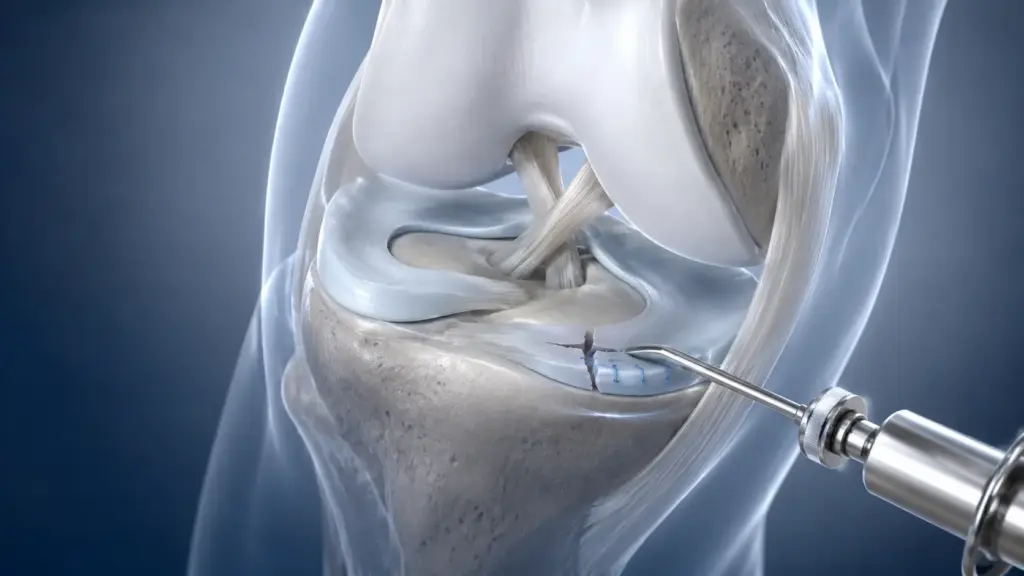
The meniscus is a C-shaped cushion of cartilage that absorbs shock and stabilises the knee. When it tears – often from a twisting injury in younger patients, or through gradual wear in older patients – surgery may be needed. Meniscal repair surgery uses sutures or specialised fixation devices to stitch the torn cartilage back together, preserving as much of the meniscus as possible, rather than simply trimming away the damaged portion (a meniscectomy).
A 2023 meta-analysis published via PubMed found that meniscal repair was associated with a lower rate of progression to knee osteoarthritis at around six years’ follow-up compared with partial meniscectomy, supporting a repair-first approach whenever the tear allows it.
Updated for 2026 to reflect current evidence on meniscal repair versus meniscectomy outcomes.
Repair is not suitable for every tear – it depends on the tear’s location, pattern, age and blood supply – which is why careful assessment, often including MRI, is essential before deciding between repair and other treatment options.
Why choose Mr Ashwin Unnithan for meniscal repair in Wimbledon?
- Named clinical interest
knee arthroscopy and meniscal repair are specifically listed among Mr Unnithan’s areas of clinical focus.
- Repair-first philosophy
a genuine preference for preserving your natural meniscus over removing it, where the tear allows, to protect your knee for the long term.
- Minimally invasive technique
performed arthroscopically through small keyhole incisions as a day case, minimising trauma to the joint.
- Senior, high-volume surgeon
over ten years’ experience as a Consultant Orthopaedic Surgeon, with sub-specialty fellowship training at the Royal National Orthopaedic Hospital.
- Honest, individualised advice
a clear explanation of whether your specific tear is genuinely repairable, and what that means for your recovery timeline.
- Diagnosis first
meniscal repair is performed via knee arthroscopy, so an accurate arthroscopic assessment always comes before any repair decision.
- Accessible for Wimbledon patients
based nearby in Walton-on-Thames, Surrey, with appointments usually available within days and no GP referral needed for an initial consultation.
- Recognised standing
Fellow of the Royal College of Surgeons, member of the British Orthopaedic Association and American Academy of Orthopaedic Surgeons, and a British Trauma Society prize-winner.
At a glance
Your treatment journey
Consultation & imaging
Examination and MRI review to assess whether your meniscal tear is suitable for repair.
Planning
A personalised surgical plan is made, including the repair technique and expected post-operative weight-bearing and bracing requirements.
Surgery & recovery
Performed arthroscopically as a day case, with a protected weight-bearing and rehabilitation protocol to allow the repair to heal securely.
Rehab & follow-up
A structured, staged physiotherapy programme and scheduled reviews guide your return to full activity over several months.
- COMMON QUESTIONS
Frequently asked questions about total hip replacement
What is meniscal repair surgery, in simple terms?
It is keyhole surgery that stitches a torn meniscus back together to preserve it, rather than trimming away the damaged portion.
Is meniscal repair better than meniscectomy (trimming)?
Where the tear is repairable, preserving the meniscus offers better long-term protection for the knee joint against future arthritis, compared with removing the torn tissue, as supported by a 2023 PubMed-indexed meta-analysis. Not every tear can be repaired, however – this depends on its location and pattern.
How long does it take to recover from meniscal repair surgery?
Recovery is longer than after a simple meniscal trim, typically involving several weeks of protected weight-bearing followed by a structured rehabilitation programme, with most patients returning to full activity around three to four months.
Will I need to wear a brace after meniscal repair?
Many patients are advised to use a brace and crutches for a period after surgery to protect the repair while it heals, and this is confirmed individually based on your surgery.
Can all meniscal tears be repaired?
No. Suitability for repair depends on the tear’s location, pattern, chronicity and blood supply. Mr Unnithan will assess this from your imaging and confirm the plan at consultation and during surgery.
Is meniscal repair surgery painful?
Discomfort is generally moderate and well managed with pain relief, though the protected rehabilitation period requires patience while the repair heals securely.
How quickly can I get an assessment for a suspected meniscal tear?
Appointments are usually available within days, and no GP referral is required for an initial consultation.
Quick appointment request
We’ll call you back within one working day.
Handled in line with UK GDPR — used only to arrange your appointment.